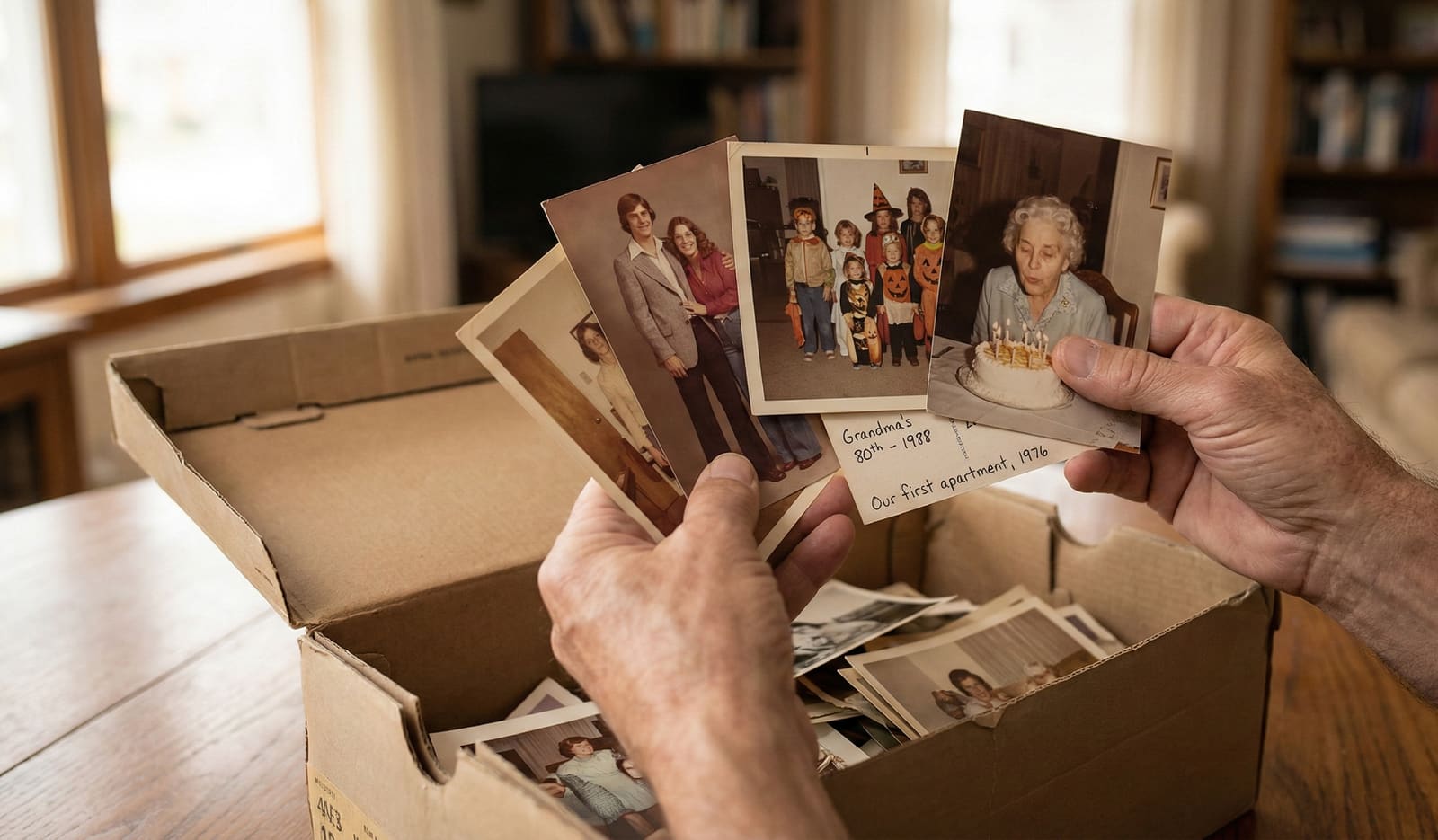
See it for yourself. Drop in one 1990s or 2000s photo and watch the range take shape.
Dating a photo from the 1990s or 2000s means placing a late-film-era print, roughly 1990 to 2010, in time by reading the visual evidence in the picture, like cars, phones, clothing, and print borders, when there is no date stamp on the back and no digital metadata to check. Most of these prints are paper, so there is nothing hidden in the file. The date lives in the picture itself, and you can learn to read it.
You know these photos. A birthday in a living room. A first day of school. A road trip. Your family remembers roughly when they happened, which is exactly what makes them tricky.
This guide shows you how to read the clues in a 1990s or 2000s photo and turn them into a date range. Then it shows how AI does the same reading across a whole collection at once.
Why is this era surprisingly hard to date?
Older photos are, in a strange way, easier. Nobody alive can check a guess about 1915. Recent photos are the opposite: they land in the falsifiable zone, and that changes everything.
Your family remembers the real date
A wrong guess gets caught. Show someone "1998" on a print they know is their 2003 wedding, and the guess is not impressive. It is simply wrong, and it burns trust in one glance. That is why a range beats a fake exact year for this era. A range that contains the true date is right. A single year the family can check is a coin flip.
These are paper prints with no metadata
Digital cameras only overtook film in the mid-2000s, and major camera makers did not stop developing new film models until around 2004 (Fstoppers). So millions of photos from the 1990s and early 2000s are prints. A print has no EXIF, no capture date, no camera model tucked in a file. The only date is the one you can see.
The one credible AI dater stops at 1990
MyHeritage PhotoDater is honest and useful, but it "provides date estimates for undated photos taken between 1860 and 1990" and only for photos that "include people" (MyHeritage help doc). It also returns a single estimated year, and it is within five years only about 60% of the time by its own reporting. So the exact era in your shoebox, recent, print-based, and full of faceless snapshots, is the era it will not even try to date. That gap is what this guide fills.
The short version: the 1990s and 2000s shoebox is recent enough that your family remembers the real date, print-based so there is no metadata, and past 1990 so the point-estimate daters refuse it. A range that contains the true date is the only claim that survives a family's memory.
What clues date a recent photo?
Dating a recent photo is detective work, and the good news is that the 1990s and 2000s left loud, datable evidence in nearly every frame. You are looking for five kinds of clues. No single one is decisive. Read together, they usually place a photo within a few years.
- Cars in or behind the frame, read by body style
- Background technology: phones, game consoles, TVs, and computers
- The print itself: borders, paper stock, and any date stamp on the back
- Film or early digital markers in the image
- Fashion and hair from a recent, fast-moving decade
Clue 1: What cars are in the frame?
A car is often your single most precise clue. Automakers change a model's shape, its body style, on a known schedule, so a vehicle in a driveway or through a window can pin a photo tightly.
- Rounded, aerodynamic shapes: 1990s onward, replacing the boxy 1980s look
- Bubble-shaped sedans and minivans: mid-to-late 1990s
- The first wave of compact SUVs and crossovers: late 1990s into the 2000s
- Sharper, more angular "new edge" styling: early-to-mid 2000s
- Projector and early LED accent headlights: mid-to-late 2000s
Worked example: a silver minivan through the window has the smooth, rounded body of the late 1990s to early 2000s. On its own, that says roughly 1997 to 2004. Now you have a ceiling and a floor before you have read anything else.
To narrow further, identify the make and model, then look up when that exact body style was sold. A model year is not the calendar year the photo was taken, but it does set the earliest possible date.
Clue 2: What phones, game consoles, TVs, and computers are in the background?
Consumer technology moved fast in these two decades, and it shows up in the background of living rooms and kitchens everywhere.
- Corded and early cordless phones: 1990s. A small flip phone on the counter points to roughly 2000 to 2006.
- Camera phones and slim smartphones: later 2000s, so their absence pushes a photo earlier.
- Boxy CRT televisions and computer monitors: 1990s through the mid-2000s. A thin flat-panel TV means roughly 2006 onward.
- Game consoles: the shapes are dated. A gray boxy console with a cartridge slot reads mid-1990s; a small purple cube or a large black console reads early 2000s; a slim white console reads later 2000s.
- Beige tower computers with a bulky monitor: late 1990s to early 2000s.
Worked example: a boxy CRT television in the corner and a small flip phone on the table, with no flat screen and no camera phone in sight, narrows a photo to about 2000 to 2005.
Clue 3: What do the print borders, paper stock, and date stamps tell you?
The physical print is evidence too, and the back of it can be a gift.
- Glossy 4x6 prints with a thin white border or no border: the standard from the late 1980s through the 2000s.
- Matte or "e-surface" finishes: more common in the 2000s.
- A printed lab logo or code on the back: ties the print to a processing run.
- The little orange or red printed date: many labs, and many cameras with a date-back feature, stamped the processing date or the shot date right on the front corner or the back. When the year is legible, it is often your single strongest clue.
Treat a stamped date as the day the print was made, which is usually close to when the picture was taken, but not always the same day. A roll of film could sit in a drawer for months before anyone developed it.
Clue 4: Does it look like film or early digital?
By the early 2000s, two very different kinds of photo were being made side by side, and they look different.
- Film markers: fine grain, warm color, red-eye from a direct flash, and a paper back. If you are holding paper, it is almost certainly film, since film ran deep into the mid-2000s.
- Early-digital markers: a softer, slightly noisy image, often in a 4:3 shape, sometimes with a date burned into the corner by the camera. First-generation consumer digital cameras arrived around 2000.
- Color shifts: a strong orange or magenta cast can mean an older print or one that has faded, which nudges you toward the 1990s.
Worked example: visible grain plus red-eye, on a glossy paper print, tells you this is film, not early digital. That alone keeps the photo in the film window, before about 2005.
Clue 5: What do the fashion and hair say?
Recent fashion moves fast, which makes it useful once you have a rough decade.
- 1990s: baggy jeans, flannel and grunge early on, then bright colors, frosted tips, and chunky sneakers late in the decade.
- Early 2000s: low-rise jeans, cargo pants, velour tracksuits, thin eyebrows, and spiky or heavily gelled hair.
- Mid-to-late 2000s: skinny jeans returning, layered "scene" haircuts, and the first wave of fast-fashion logos.
- Glasses and frames: thin wire frames read late 1990s; thicker plastic frames return in the mid-2000s.
Fashion is a confirming clue, not a lead one. Use it to check the range your harder clues already gave you.
What is the Phossil Method?
The Phossil Method is a simple way to combine these clues into a dated range. It has one rule that most tools break: never collapse to a fake single day.
- Read each clue on its own. Give every clue its own span of years. The car says one range. The television says another. The print says a third.
- Layer the independent clues. Lay the ranges over each other. Clues that come from different evidence, a car and a phone and a paper stock, are independent, so agreement between them is meaningful.
- The overlap is your range. Where the spans all agree is your date range. If the car says 1997 to 2004 and the tech says 2000 to 2005 and the film says before 2005, the overlap is about 2001 to 2004.
- Keep a confidence band. State the range, not a single day. A range that contains the true date is right. A single year your family can check is a guess waiting to be caught.
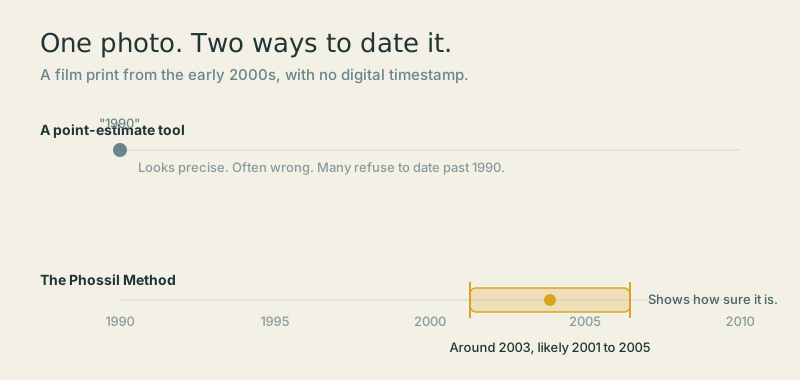
This is the same idea behind Phossil's dating engine, which uses Bayesian temporal inference to weigh many clues at once and return a range with a confidence band. You can read the research behind it here, and you can correct any estimate in a single tap. Independent academic work points the same way: a 2025 paper describes "a probabilistic framework that formally combines visual evidence" to infer the year a photo was taken (Paplham and Franc, arXiv, 2025). Probabilistic, evidence-layering dating is the serious method, not a hedge.
Can you walk through a full example?
Let us take one photo from start to finish.
Example Analysis
Photo: a glossy 4x6 print with a thin white border. A child's birthday party in a living room. A window in the background looks out on the driveway.
Step 1: Read the car
- A compact SUV in the driveway with a rounded, early-2000s body style
- Not the boxy 1980s look, not the sharper late-2000s styling
- Car estimate: 1999 to 2005
Step 2: Read the technology
- A boxy CRT television in the corner, no flat screen
- A small flip phone on the counter, no camera phone in sight
- Technology estimate: 2000 to 2004
Step 3: Read the print
- Glossy paper with a thin white border, so this is a film print
- Visible grain and red-eye from a direct flash confirm film, not early digital
- Print estimate: film era, before about 2005
Step 4: Layer the clues (the Phossil Method)
- Car: 1999 to 2005
- Technology: 2000 to 2004
- Print: before about 2005
- The overlap of all three is where the truth sits
Final estimate: around 2001 to 2004
Notice what you did not do: you did not announce a single day. You gave a four-year range with a confidence band, and any one of those clues could still tighten it if you find a legible date stamp on the back.
Where can you learn more about dating old photographs?
These free, authoritative references go deeper on reading physical and visual evidence.
Museums and archives:
- Library of Congress, Prints and Photographs Division, a free reference for photographic formats and processes
- Graphics Atlas, the Image Permanence Institute's museum-grade guide to identifying photographic prints
On the film-to-digital crossover:
- Fstoppers, on digital cameras overtaking film in the mid-2000s
- Jonathan Gorse Photography, citing Photo Marketing Association figures for the same shift
More from Phossil:
- How to Date Old Photographs, the complete guide from 1839 to today
- Phossil vs a point-estimate photo dater, why a range beats a single year
- The Bayesian temporal engine, the research behind the dating method
Common questions
How do you date a photo from the 1990s or 2000s?
Read several clues in the picture and combine them. Look at cars and their body styles, background technology like phones, game consoles, and televisions, the print border and paper, any date stamp on the back, whether the image looks like film or early digital, and the fashion and hair. Each clue gives a span of years. Where the spans overlap is your date range.
Why does MyHeritage PhotoDater not date photos after 1990?
MyHeritage says PhotoDater provides date estimates for undated photos taken between 1860 and 1990, and only for photos that include a visible person. It also returns a single estimated year. A single year is safe only on photos so old that nobody can check it. On a 2003 photo your family remembers, one exact year is easy to prove wrong, which is why the 1990s and 2000s are outside its window.
How can you tell a film print from an early digital photo?
Film prints tend to show fine grain, warm color, red-eye from a direct flash, and a paper back that may carry a printed processing code. Early digital photos from about 2000 onward look softer, are often slightly noisy, and are usually a 4:3 shape. If you are holding paper, it is almost certainly a film print, since film ran deep into the mid-2000s.
What are the little orange or red numbers on the back of a photo?
They are usually the processing date the photo lab printed on the back, and sometimes a frame or roll code. When the year is legible, it is often the single strongest clue you have. Treat it as the date the print was made, which is usually close to when the picture was taken, but not always the same day.
Can you date a 1990s or 2000s photo with no people in it?
Yes. Face-based tools ignore photos without a visible person, but a photo of a house, a car, a living room, or a landscape is full of datable evidence. Vehicles, televisions, phones, signage, and the print itself all carry their own date ranges. The Phossil Method reads that context, so faceless photos still get a date range with a confidence band.
The takeaway
The 1990s and 2000s are not too recent to date. They are simply too recent for a fake single year to survive. Read the cars, the technology, the print, and the film clues, layer them with the Phossil Method, and land on a range you can defend.
That is exactly what Phossil does for a whole collection at once: it reads every photo, gives each a date range with a confidence band, and rebuilds them into one family timeline. See how it is built and priced when you are ready.