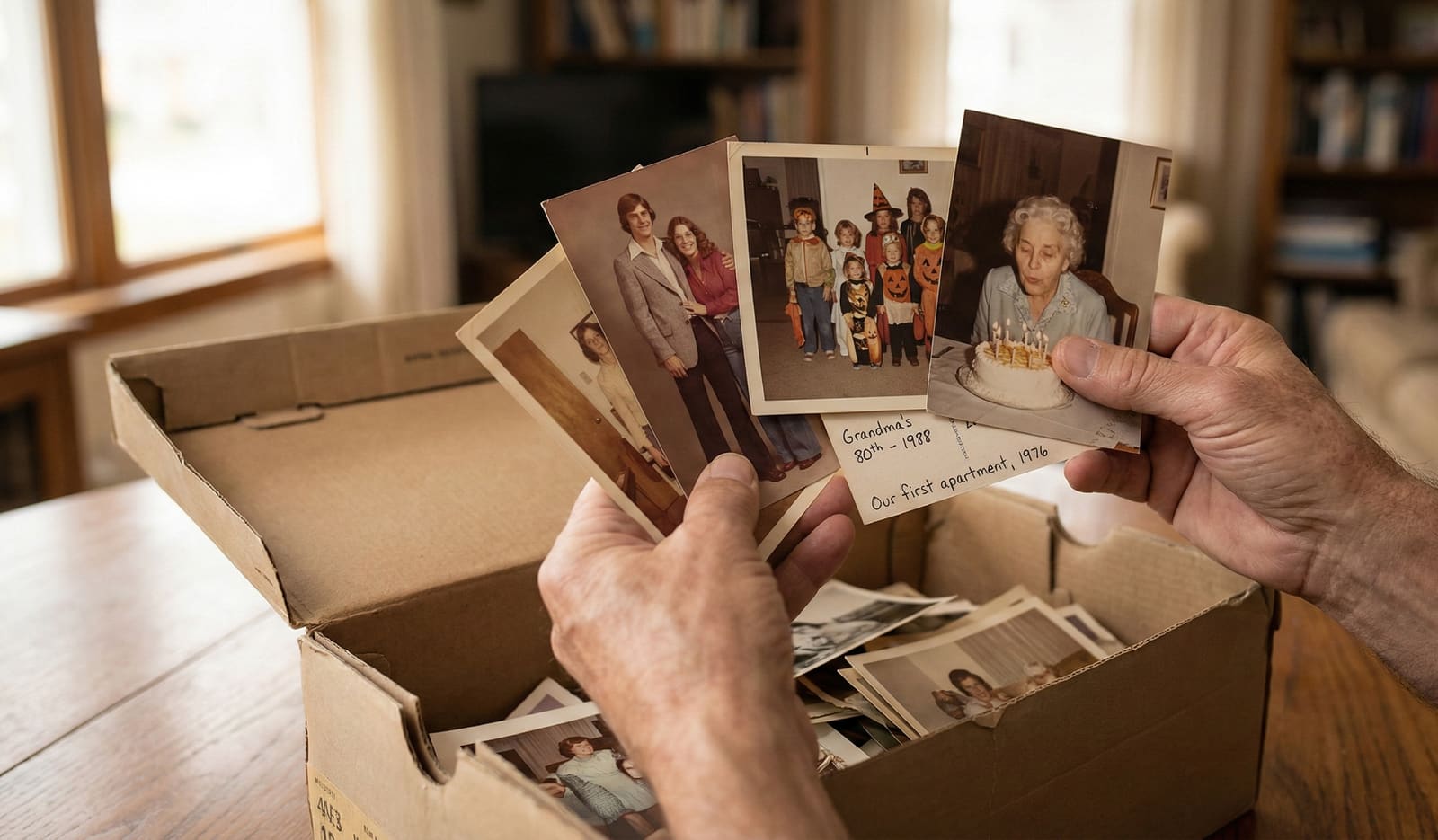
To date an old photo, read four kinds of evidence in the image itself: the photo's physical format, the clothing and hairstyles, the background objects and technology, and the known ages of anyone you recognize. No single clue is decisive, but read together they usually place an undated photo within a decade or two. The scanner above applies exactly this method. The rest of this guide teaches you to read the same evidence yourself.
You found an old photo. No date on the back. No writing at all. Just faces staring back at you from another era.
When was this taken? Who are these people? What was the occasion?
These questions matter. A photo from 1910 tells a different story than one from 1940. Knowing the date helps you identify the people, understand the context, and place the image in your family's timeline.
This guide will teach you how to estimate when a photo was taken using clues in the image itself.
The Four Categories of Clues
Dating old photos is detective work. You're looking for evidence in four main categories:
- The photo itself (format, size, printing technique)
- What people are wearing (clothing, hairstyles, accessories)
- What's in the background (furniture, cars, buildings, technology)
- The people themselves (if you can identify anyone and know their approximate age)
No single clue is definitive. You're building a case from multiple pieces of evidence, narrowing down a range until you have a reasonable estimate.
Photo eras at a glance
Use this as a fast first pass. Match the format and the most obvious clues to an era, then confirm with the detailed sections below.
| Era | Common formats | Tell-tale visual cues | Typical range |
|---|---|---|---|
| Cased-image era | Daguerreotype, ambrotype | Image on metal or glass in a hinged case, mirror-like surface, stiff formal pose | 1839-1865 |
| Carte de visite era | Carte de visite (CDV), tintype | Small card-mounted prints, hoop skirts, Civil War uniforms | 1860-1875 |
| Cabinet card era | Cabinet card, tintype | Larger card mounts with printed borders, bustle dresses, painted studio backdrops | 1875-1900 |
| Early snapshot era | Gelatin silver prints, real-photo postcards | Brownie-camera snapshots, leg-of-mutton sleeves, high lace collars | 1900-1918 |
| Roaring twenties | Small glossy prints, postcards | Drop-waist dresses, bobbed hair, early automobiles in frame | 1918-1930 |
| Mid-century | Deckle-edge and borderless prints | Square formats, 1940s shoulder pads, 1950s full skirts and saddle shoes | 1930-1959 |
| Color era | Kodachrome and Kodacolor prints | Color snapshots, white borders sometimes stamped with a processing date, suburban settings | 1960 onward |
Part 1: The Photo Format
The physical format of a photo is often your strongest clue. Photography technology changed dramatically over the decades, and different formats dominated different eras.
| Format | Era | Key Identification Features |
|---|---|---|
| Daguerreotype | 1839-1860 | Mirror-like silver surface, housed in hinged case, image shifts when tilted |
| Ambrotype | 1854-1865 | Glass plate with dark backing, housed in case, image doesn't shift |
| Tintype | 1856-1930s | Thin iron sheet (magnet sticks), grayish-brown tone, often in paper sleeve |
| Carte de Visite (CDV) | 1859-1910 | 2.5" × 4" card mount, photographer's imprint on back |
| Cabinet Card | 1866-1920s | 4.25" × 6.5" mount, ornate studio branding, thicker cardstock |
| Snapshot / Kodak Print | 1900-present | Paper print, size varies by era, often with date stamps on back |
Daguerreotypes
1839-1860The earliest photos. One-of-a-kind images on a mirror-like silver surface. They appear positive or negative depending on the viewing angle.
How to identify:
- Highly reflective surface
- Usually housed in hinged cases with velvet lining
- Image can appear as a negative when tilted
- Typically small (2x3 inches or smaller)
Peak popularity: 1840-1855
Ambrotypes
1854-1865Glass negatives backed with dark material to appear as positives. Also housed in cases.
How to identify:
- Glass plate (may show chips or cracks at edges)
- Dark backing visible if you look at edges
- Usually in hinged cases like daguerreotypes
- Image doesn't shift appearance when tilted (unlike daguerreotypes)
Most common: 1855-1860
Tintypes / Ferrotypes
1856-1930sImages on thin iron sheets. Cheap and durable, popular with traveling photographers and at fairs.
How to identify:
- Thin metal plate (a magnet will stick to it)
- Often have a grayish or chocolate-brown tone
- May be in paper sleeves or small cases
- Later tintypes often have stamped decorative borders
Most common: 1860-1890
Cartes de Visite / CDVs
1859-1910Small paper photos mounted on card stock, about the size of a business card (2.5 x 4 inches). Designed to be collected and traded.
How to identify:
- Mounted on thick cardboard
- Size approximately 2.5 x 4 inches
- Often have photographer's name and location on the back
- Square corners until ~1870, rounded corners after
Most popular: 1860-1880
Additional dating clues:
- Thin card stock: 1860s
- Thicker card with square corners: 1860-1870
- Rounded corners: 1870 onward
- Colored or decorated borders: 1880s onward
- Photographer imprint on front: more common after 1880
Cabinet Cards
1866-1920sLarger mounted photos (4.25 x 6.5 inches), replaced CDVs as the standard portrait format.
How to identify:
- Mounted on thick cardboard
- Size approximately 4.25 x 6.5 inches
- Often elaborate designs on the card mount
- Photographer's information usually printed on the back or bottom
Most common: 1880-1900
Additional dating clues:
- Simple mounts with thin borders: 1866-1880
- Elaborate printed designs, gold edges: 1880-1890
- Beveled edges: 1880s onward
- Very thick mounts with embossing: 1890s
- Muted colors, simpler designs: 1900-1910
Snapshot Era Photos
After 1888, Kodak's "you press the button, we do the rest" revolution made photography accessible to amateurs.
Kodak snapshot formats:
| Format | Size | Date Range |
|---|---|---|
| Circular Kodak | 2.5" diameter | 1888-1889 |
| Early Kodak prints | Various small sizes | 1889-1900 |
| Postcard backs | 3.5 x 5.5 inches | 1900s-1920s |
| Standard snapshot | 2.5 x 4.25 inches | 1910s-1930s |
| Larger amateur print | 3.5 x 5 inches | 1930s-1950s |
| Square format (Brownie) | 3.5 x 3.5 inches | 1900s-1960s |
| Instamatic square | 4 x 4 inches | 1963-1980s |
| Standard 35mm print | 3.5 x 5 inches | 1960s-1990s |
| Modern standard | 4 x 6 inches | 1980s-2000s |
Border Styles as Dating Clues
The borders on photos evolved predictably:
- No border / full bleed: Early snapshots, professional prints
- Thin white border: 1930s-1950s
- Wide white border: 1950s-1970s
- Deckled (wavy) edges: 1940s-1960s
- Rounded corners: 1960s-1980s
- Black borders: Often Polaroid, 1960s-1990s
- White borders, straight edges: 1980s-2000s
Color Photography Timeline
- Hand-tinted prints: Any era, but common 1900-1950
- Autochrome (early color): 1907-1935
- Kodachrome slides: 1935 onward
- Consumer color prints (common): 1960s onward
- Color prints dominant over B&W: Late 1970s
If you have a color print, it's most likely from 1960 or later. If the color has a distinct orange or magenta shift, it's likely from the 1970s-1980s (when color print chemistry was less stable).
Part 2: Clothing and Fashion
Clothing is one of the most reliable dating tools, but it requires some study. Fashion changed constantly, and even small details can narrow your date range significantly.
Women's Fashion Overview
1840s-1850s:
- Wide skirts over petticoats
- Bonnets worn outdoors
- Hair parted in the middle, smooth, often with curls at ears
- Off-shoulder necklines for formal wear
1860s:
- Extremely wide hoop skirts (widest point: mid-1860s)
- Pagoda sleeves (wide at the wrist)
- Small hats or hair nets
- Hair often in a net or snood at the back
1870s:
- Bustle appears (fullness moves to the back)
- Narrower skirts in front
- Higher necklines
- Hair pulled up and back
1880s:
- Bustle at its largest (mid-1880s)
- Very narrow, form-fitting bodices
- High collars
- Hair piled high on the head
1890s:
- Bustle disappears
- Leg-of-mutton sleeves (huge puffed shoulders, tight forearms)
- Hourglass silhouette
- Hair remains up but softer
1900s:
- S-bend corset creates distinctive posture
- High collars, often with lace
- Pompadour hairstyle
- Large hats
1910s:
- Narrower silhouette
- Hobble skirts (very narrow at ankle)
- Lower waistlines by end of decade
- Softer hairstyles
1920s:
- Dropped waist or no waist
- Shorter hemlines (knees visible by mid-1920s)
- Bobbed hair
- Cloche hats
- Straight, boyish silhouette
1930s:
- Waist returns to natural position
- Longer hemlines
- Bias-cut dresses (cling to body)
- Waved or curled hair
- Shoulder pads begin appearing late in decade
1940s:
- Strong shoulder pads
- A-line skirts (wartime fabric rationing)
- Victory rolls and other elaborate updos
- Practical styles during war years
1950s:
- Full skirts with petticoats
- Cinched waists
- Poodle skirts, circle skirts
- Ponytails, bouffant hairstyles
1960s:
- Shift dresses
- Miniskirts (mid-late 1960s)
- Bouffant hair early, straight hair later
- Mod styles, geometric shapes
1970s:
- Bell bottoms, flared pants
- Platform shoes
- Maxi skirts and hot pants
- Feathered hair
1980s:
- Big shoulders, power suits
- Neon colors
- Big hair (perms, teased styles)
- Leg warmers, athletic wear as fashion
Men's Fashion Overview
Men's fashion changed more slowly, but key details help with dating:
Facial hair trends:
- Clean-shaven: 1840s-1850s, 1900s-1960s
- Full beards: 1860s-1890s
- Mustaches alone: 1880s-1920s, 1970s-1980s
- Sideburns: 1840s-1850s (moderate), 1870s (long), 1960s-1970s (wide)
Suit lapels:
- Narrow lapels: 1960s, early 1980s
- Wide lapels: 1930s-1940s, 1970s
- Moderate lapels: 1950s, 1990s-2000s
Tie width:
- Narrow ties: 1960s, early 1980s
- Wide ties: 1940s, 1970s
- Bow ties common: 1900s-1960s
Collar styles:
- High starched collars: 1890s-1910s
- Soft collars: 1920s onward
- Point collars: Most common, all eras
- Wide spread collars: 1930s-1940s, 1970s
Hat styles:
- Top hats: Formal wear through 1930s
- Bowler/Derby: 1880s-1930s
- Fedora: 1920s-1960s
- Men commonly wore hats outdoors: Until 1960s
Children's Clothing Clues
- Boys in dresses: Common for young boys until 1920s
- Short pants for boys: Standard until age 12-14 through 1950s
- Long hair on young boys: Common into the 1900s
- Sailor suits: Popular 1880s-1930s
- Knickers (knee pants): 1900s-1930s
Part 3: Background and Setting
What's visible behind the subjects can provide dating clues.
Studio Backdrops
Professional photographers used painted backdrops that followed trends:
- Plain dark backgrounds: 1840s-1860s (technical necessity)
- Painted nature scenes: 1870s-1890s
- Elaborate parlor settings: 1880s-1900s
- Classical columns and balustrades: 1890s-1910s
- Mottled or softly graded backgrounds: 1910s-1930s
- Plain, unadorned backgrounds: 1940s onward
Automobiles
If a car is visible, it's often your best dating clue. Car designs changed rapidly.
Quick automobile dating:
- Open carriages, no enclosed cabs: Pre-1915
- High, boxy shape with running boards: 1915-1935
- Rounded, streamlined shapes: 1936-1948
- Chrome and fins begin: Late 1940s
- Extreme fins: 1955-1965
- Muscle car era: 1964-1972
- Boxy, angular shapes: 1975-1990
- Rounded aerodynamic shapes: 1990s onward
For precise dating, identify the car make and model using online resources like OldCarBrochures.com or automotive history sites.
Technology and Objects
- Telephones: Wall-mounted crank phones (1900s-1930s), candlestick phones (1920s-1940s), rotary desk phones (1930s-1970s), push button (1960s onward)
- Television: Appears in homes 1950s
- Christmas trees: Electric lights become common 1920s
- Cameras visible in photos: Kodak Brownie (1900s-1960s), Instamatic (1963-1980s), disc cameras (1982-1990s)
Architecture and Interior Design
- Victorian parlors: Heavy drapes, ornate furniture, dark colors (1870s-1900s)
- Arts and Crafts style: Mission furniture, simpler lines (1900s-1920s)
- Art Deco: Geometric patterns, chrome, mirrors (1920s-1930s)
- Mid-century modern: Clean lines, organic shapes (1945-1970)
- Avocado and harvest gold: 1970s
- Wood paneling: 1960s-1980s
- Track lighting: 1980s
Part 4: Using Known Information
If you can identify anyone in the photo, you can use what you know about them to narrow the date.
Age Estimation
If you know when someone was born, estimate their age in the photo:
- Study the person's apparent age
- Calculate possible year ranges based on their birth year
- Cross-reference with other clues in the photo
For example: If you know Grandma was born in 1920 and she appears to be in her 20s, the photo was likely taken 1940-1950.
Life Events
Major life events create date boundaries:
- Before/after marriage (wedding rings, name changes)
- Before/after military service (uniforms, insignia)
- Before/after children were born
- Before/after a move to a new location
- Before/after someone's death
Location Clues
Photographer's marks on cabinet cards and CDVs tell you where the photo was taken. If you know when family members lived in certain locations, you can narrow the date.
Part 5: AI-Assisted Dating
Everything above took decades of expertise to master. Or you can hand the photo to Phossil and let it read the evidence for you.
The New Standard: The Phossil Method
Most AI dating tools look at one thing, usually faces and fashion. The Phossil Method uses Bayesian temporal inference to analyze everything in the frame simultaneously:
- Multi-signal fusion: Paper texture, clothing, objects, faces, even handwriting, combined into a unified probability estimate
- Works beyond portraits: Dates scenery, vehicles, architecture, storefronts, and document photos
- Dates the photos other tools refuse: 1990s and 2000s color prints and phone snapshots, not just pre-1990 portraits
- Shows its work: returns a dated range with a confidence band, never a false exact year, and you can correct any guess in one tap
- One upload: the photo goes in, a dated range and its evidence come back
Try it free: Upload your first 100 photos and watch the Phossil Method date them automatically. No credit card required.
See the research behind the Phossil Method
Other Options
MyHeritage PhotoDater:
Free with a MyHeritage account. A decent starting point.
- Analyzes photos from 1860-1990
- ~60% accurate within five years
- Only works on photos with visible faces
- Single-signal analysis (fashion only)
We put the two approaches side by side: Phossil vs a point-estimate photo dater, including the photos after 1990 that PhotoDater leaves undated.
Combining AI and Manual Analysis
The best approach combines AI estimates with your own detective work:
- Upload the photo to an AI dating tool for an initial estimate
- Note the confidence level and date range provided
- Examine the photo yourself for clues the AI might miss or misinterpret
- Cross-reference with known information about people in the photo
- Arrive at a final estimate based on all available evidence
AI is particularly helpful for:
- Getting a quick initial estimate
- Confirming your own analysis
- Dating photos where you have no other clues
AI is less reliable for:
- Photos outside its training data (unusual formats, very early or very recent photos)
- Images with few visible people or fashion details
- Photos from cultures or regions underrepresented in training data
Part 6: Putting It All Together
Let's walk through a dating analysis step by step.
Example Analysis
Photo: Black and white photo of a woman, mounted on thick cardboard with rounded corners. Photographer's mark on back: "Johnson Studio, Chicago."
Step 1: Format analysis
- Cabinet card format (4.25 x 6.5 inches)
- Rounded corners suggest post-1870
- Thick mount with beveled edge suggests 1880s-1890s
- Format estimate: 1880-1900
Step 2: Fashion analysis
- High collar with lace
- Hair piled high on head
- Leg-of-mutton sleeves (puffed at shoulder, tight at forearm)
- Fitted bodice
- Fashion estimate: 1890-1897 (leg-of-mutton sleeves were highly specific to this period)
Step 3: Background analysis
- Classical column and drape backdrop
- Consistent with 1890s studio conventions
- Background estimate: 1885-1900
Step 4: Cross-reference
- Photographer's mark can be researched (city directories, historical records)
- If Johnson Studio operated in Chicago from 1888-1905, that narrows further
Final estimate: 1890-1897
The leg-of-mutton sleeves are the strongest clue here, as they were fashionable for only a brief period.
Quick Reference: Dating Checklist
Use this checklist when examining an unknown photo:
Physical format:
- What type of photo? (daguerreotype, tintype, cabinet card, snapshot, etc.)
- What size?
- What are the borders like?
- Is there a photographer's mark?
- Is it color or black and white?
People:
- Can you identify anyone?
- What are they wearing?
- What hairstyles are visible?
- Any facial hair styles?
- Any uniforms, jewelry, or accessories?
- How old do the subjects appear?
Background:
- Is this a studio portrait or candid shot?
- What type of backdrop is used?
- Are any vehicles visible?
- Any technology visible? (phones, TVs, cameras)
- Any architecture or interior design clues?
Known information:
- Do you recognize the location?
- Can you identify any life events? (wedding, graduation, military service)
- Does the photographer's location match known family history?
Resources for Further Research
Books:
- Dressed for the Photographer: Ordinary Americans and Fashion, 1840-1900 by Joan Severa
- Dating Old Photographs by Robert Pols
- Family Photo Detective by Maureen Taylor
Websites:
- FamilySearch.org/wiki has detailed guides on photo dating
- PhotoTree.com provides era-specific clothing reference
- Library of Congress Prints and Photographs Division (free historical image reference)
Fashion databases:
- Metropolitan Museum of Art Costume Institute (online collection)
- Victoria and Albert Museum fashion collection
Automobile identification:
- OldCarBrochures.com
- Hemmings.com
More from Phossil:
- How to Date a Photo From the 1990s or 2000s, the recent decades where format clues run out
- Phossil vs a point-estimate photo dater, why a range beats a single year
Conclusion
Dating old photos is equal parts science and art. The more you practice, the better you'll become at recognizing the visual markers of different eras.
Start with the easiest clues (photo format), then layer in more subtle evidence (fashion, background, known information). When all your clues point to the same range, you can be reasonably confident in your estimate.
And remember: even professional photo historians sometimes disagree about dates by a decade or more. Getting within a 10-year range is often the best anyone can do with limited information.
The goal isn't perfect precision. It's understanding enough to place the photo in context, identify the people, and connect it to your family's story.
Common questions
How can I tell when an old photograph was taken?
Look for four categories of clues: the photograph format (daguerreotype, tintype, cabinet card, etc.), what people are wearing (clothing, hairstyles, accessories), what's in the background (furniture, cars, technology), and the people themselves if you can identify anyone and know their approximate age.
What is a daguerreotype and when were they made?
Daguerreotypes were the earliest photographs, made 1839-1860 with peak popularity 1840-1855. They're one-of-a-kind images on a mirror-like silver surface, appearing positive or negative depending on viewing angle. They're usually housed in hinged cases with velvet lining and are typically small (2x3 inches or smaller).
How do I identify a cabinet card photo?
Cabinet cards (1866-1920s) are mounted photographs approximately 4.25 x 6.5 inches on thick cardboard with elaborate designs. Dating clues: simple mounts with thin borders (1866-1880), elaborate printed designs and gold edges (1880-1890), beveled edges (1880s+), very thick mounts with embossing (1890s), and simpler designs (1900-1910).
What is a tintype photograph?
Tintypes (1856-1930s) are images on thin iron sheets, popular with traveling photographers and at fairs. They have a grayish or chocolate-brown tone and a magnet will stick to them. Most common 1860-1890. They may be in paper sleeves or small cases, with later ones having stamped decorative borders.
How can clothing help date an old photograph?
Fashion changed dramatically across decades. Look for: hoop skirts (1850s-1860s), bustle dresses (1870s-1890s), leg-o-mutton sleeves (1890s), dropped waist dresses (1920s), shoulder pads (1940s), poodle skirts (1950s). Men's collar styles, tie widths, and lapel sizes also changed predictably over time.
Can AI help date old photographs?
Yes. Phossil's engine uses Bayesian inference to weigh many signals at once (clothing, format, faces, objects, even paper texture) and returns a dated range with a confidence band instead of a single false-precise year. Unlike single-signal tools that stop around 1990 and need a visible face, it also dates 1990s and 2000s color and phone snapshots, plus scenery, vehicles, and architecture.