See it for yourself. Drop in one 1970s or 1980s print and watch the range take shape.
Dating a photo from the 1970s or 1980s means placing a color-print-era photo, roughly 1965 to 1990, in time by reading the print itself: its size and border, the code printed on its back, its color cast, and the fashion and rooms in the frame, when there is no legible date stamp to hand you the year. This is the era when the paper does half the work. Labs stamped dates, Kodak dated its own paper stock, and print formats changed on a known schedule. The date lives in the object as much as the image, and you can learn to read both.
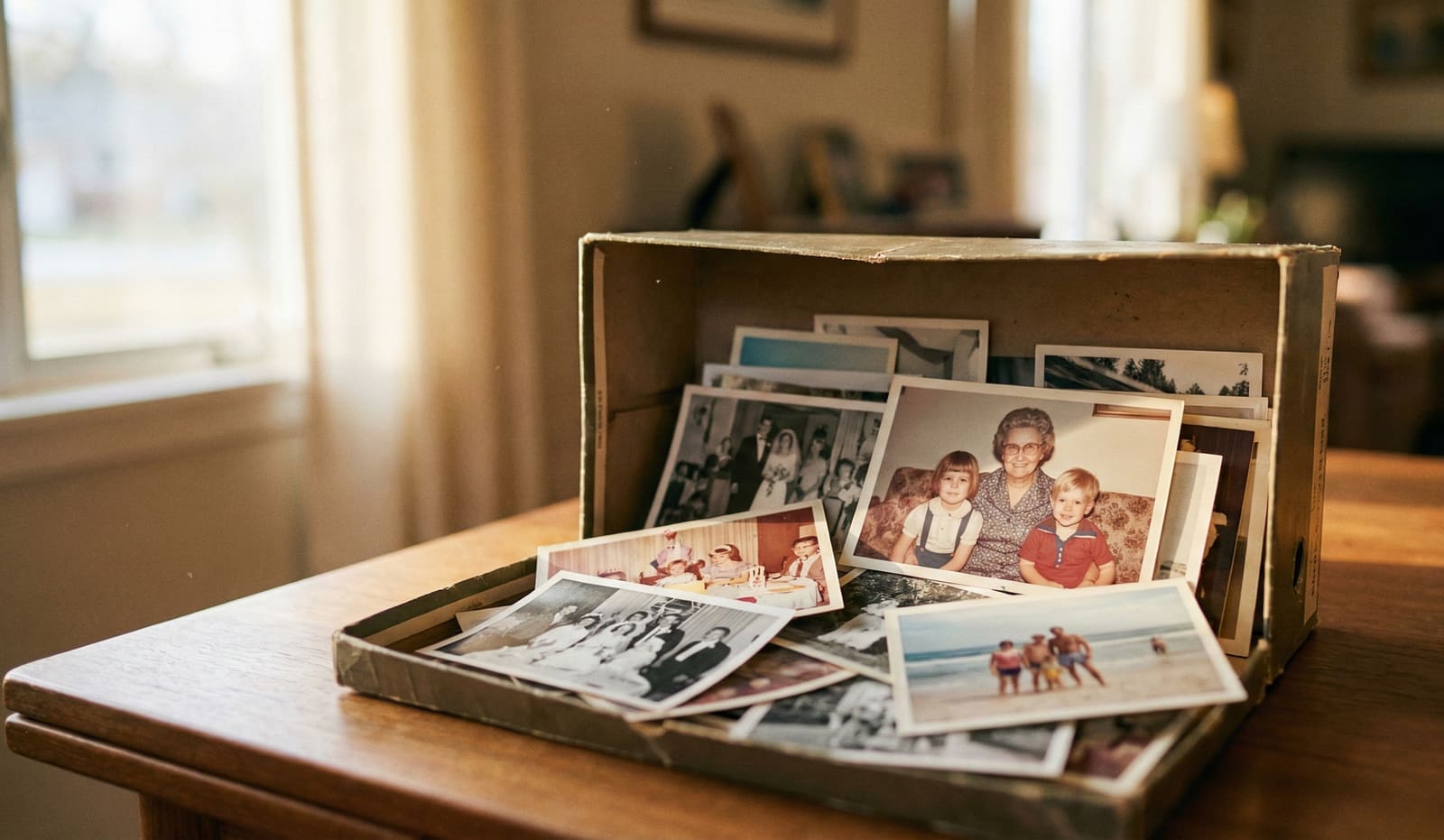
You know these photos. A square print of a backyard barbecue. A faded orange Christmas morning. A stack from a drugstore envelope nobody ever labeled.
This guide shows you how to read the clues in a 1970s or 1980s photo and turn them into a date range. Then it shows how AI does the same reading across a whole collection at once. If your box runs later, the sibling guide covers dating 1990s and 2000s photos.
Why does this era reward the careful reader?
The 1970s and 1980s sit in a sweet spot for photo dating: recent enough that the prints survive in bulk, old enough that the physical print still carries manufacturing evidence that later eras dropped.
The print is a document of its own
A color print from this era is not just an image. It is a manufactured object with a format, a border style, a paper stock, and usually printing on the back, and every one of those changed on a documented schedule. Before you have looked at a single face, the object in your hand has already given you a span of years.
The people who remember are getting harder to ask
For photos taken from 1950 to 1980, the people who can still name the faces and places are mostly in their seventies and eighties. Our photo preservation crisis report puts the remaining identification window for this era at 10 to 20 years. Dating the prints now, while someone can still confirm "that was the summer at the lake house," turns a guess into a record.
The point-estimate daters cover this era, but thinly
MyHeritage PhotoDater does cover the 1970s and 1980s, since its window runs from 1860 to 1990, but it returns a single estimated year and only works on photos that include a visible person. A slide tray, a print of the house, a car in the driveway: all skipped. And a single year on a photo your parents remember is easy to prove wrong. The deeper comparison is in Phossil vs a point-estimate photo dater.
The short version: the color-print era hands you physical evidence that later eras lost, the paper, the border, the code on the back, while the window for confirming names and places is 10 to 20 years and closing. A range that contains the true date, checked against a living memory, is the strongest record you can make.
What clues date a color print?
Dating a color print is detective work, and this era left evidence on both sides of the paper. You are looking for five kinds of clues. No single one is decisive. Read together, they usually place a photo within a few years.
- The print format: size, borders, corners, and surface texture
- The back of the print: paper-back codes, lab stamps, and date stamps
- The color cast: how the dyes have aged
- Instant prints: the Polaroid format families
- Fashion, hair, and rooms from two loud decades
Clue 1: What do the print format and borders tell you?
Print sizes and border styles turned over on a known schedule, which makes the shape of the print your fastest first cut.
- Deckled (wavy) edges: mostly gone by the early 1970s, so their presence pushes a print to the late 1960s or earlier
- Square prints, about 3.5 inches: 126 Instamatic film, mostly 1963 to about 1980, peaking in the early 1970s
- White borders on rectangular prints: common through the 1960s, fading out in the early-to-mid 1970s
- Rounded corners: roughly 1968 to 1980
- Small, grainy rectangular prints: 110 pocket film, 1972 through the 1980s
- Borderless 3.5x5 prints with a silk or matte texture: mid 1970s into the mid 1980s
- Very grainy prints from tiny negatives: disc film, 1982 to about 1990
- Glossy 4x6 prints: mid-to-late 1980s onward, as 35mm point-and-shoots and one-hour minilabs spread
Worked example: a borderless 3.5x5 print with rounded corners and a silk texture reads roughly 1974 to 1982 before you have looked at the image at all. Now you have a floor and a ceiling from the paper alone.
Size is the fastest sort key for a whole box: square says the 126 era, 3.5x5 says 1970s to mid 1980s, 4x6 says mid 1980s onward. Sort by shape first and the box starts dating itself.
Clue 2: What does the back of the print say?
Turn the print over. The back of a color-print-era photo can be the most datable surface on it.
- "A Kodak Paper": this backprint ran from about 1963 to 1972
- "This paper manufactured by Kodak": from about 1972 into the late 1980s
- Other brand backprints: Fuji, Agfa, and 3M printed their own paper backs on the same idea; any brand backprint ties the print to that paper's production window
- The drugstore date stamp: many labs stamped a processing month and year on the border or the back, and many Kodak-processed prints of the 1960s and 1970s carry it on the front border. When the year is legible, it is usually your single strongest clue.
- Orange digits burned into the image corner: a camera date-back feature, mid 1980s onward, so its presence pushes a print late in the era
- Handwriting on the back: read it, but hold it loosely. Captions were often added years later, from memory.
Treat a stamped date as the day the print was made, which is usually close to when the photo was taken, but not always. A roll of film could sit in a camera or a drawer for months, sometimes years, before anyone developed it.
Clue 3: What does the color cast tell you?
Color prints from this era are chemical objects, and their chemistry is aging on a schedule of its own.
- Heavy overall fade with a warm drift: whites gone cream, the whole image leaning orange, red, or magenta. This is classic 1970s dye fade and nudges a print toward the earlier decade.
- Bolder, better-held color: paper stocks improved through the 1980s, so a print that still shows strong clean color usually reads later in the era.
- Consumer prints of the 1970s to 1990s shipped with 15 to 30 year expected lifespans, which means many are past their design life and actively fading now. The numbers are laid out in our preservation crisis report.
One candid limit: fading depends on storage as much as age. A print kept in a dark album fades slower than one taped to a sunny kitchen wall. Use the cast as a nudge between decades, never as your lead clue.
Clue 4: Which Polaroid format is it?
Instant prints date by format family, and two of the families have tight, documented windows.
- Peel-apart pack film: a rectangular print, often with a slight gloss and roller marks, from 1963 into the late 1970s in family use
- The integral square in a white plastic frame: SX-70 film, from 1972 onward, with the thick lip at the bottom
- The 600 series: from 1981, the same square-in-a-frame look. Telling SX-70 from 600 by eye is hard, so read the family, not the model: an integral square Polaroid says 1972 onward.
- A Kodak-branded instant print: one of the tightest markers in the whole era. Kodak sold instant film only from 1976 to 1986, then left the market after a patent case with Polaroid.
Worked example: a square instant print in a white frame, marked Kodak on the back, can only have been made between 1976 and 1986. A ten-year window from the brand name alone.
Clue 5: What do the fashion, hair, and rooms say?
These two decades moved loudly, in clothes and in living rooms, which makes the scene a strong confirming layer.
- Wide lapels, wide collars, and bell-bottoms: about 1968 to 1978
- Long hair and wide sideburns on men: peaking in the early-to-mid 1970s
- Feathered hair: about 1976 to 1983
- Perms, mullets, and shoulder pads: about 1983 to 1990
- Big plastic eyeglass frames: about 1975 to 1990
- Avocado green and harvest gold appliances: about 1968 to 1978
- Wood paneling and shag carpet: about 1970 to 1982
- Mauve, dusty blue, oak, and brass in the room: about 1984 to 1992
- A VCR under the television: 1982 onward
- Cars: chrome bumpers and vinyl roofs read 1970s; boxy, angular shapes read 1980s; the first minivans appear about 1984
One caution: rooms age slower than clothes. A harvest gold refrigerator sets a soft floor, not a hard one, because appliances outlive their fashion by years. Let the clothes and hair carry more weight than the walls.
What is the Phossil Method?
The Phossil Method is a simple way to combine these clues into a dated range. It has one rule that most tools break: never collapse to a fake single day.
- Read each clue on its own. Give every clue its own span of years. The print format says one range. The paper back says another. The kitchen says a third.
- Layer the independent clues. Lay the ranges over each other. Clues that come from different evidence, a border style and a backprint and a hairstyle, are independent, so agreement between them is meaningful.
- The overlap is your range. Where the spans all agree is your date range. If the print says 1974 to 1982 and the kitchen says 1968 to 1978 and the hair says 1976 to 1983, the overlap is about 1976 to 1978.
- Keep a confidence band. State the range, not a single day. A range that contains the true date is right. A single year your family can check is a guess waiting to be caught.
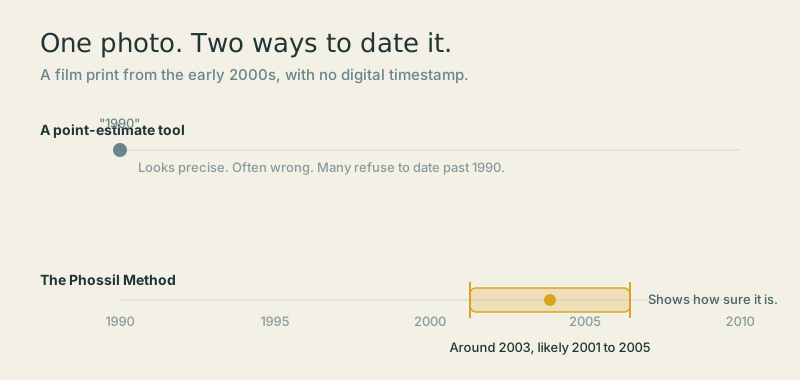
This is the same idea behind Phossil's dating engine, which uses Bayesian temporal inference to weigh many clues at once and return a range with a confidence band. You can read the research behind it here, and you can correct any estimate in a single tap. Independent academic work points the same way: a 2025 paper describes "a probabilistic framework that formally combines visual evidence" to infer the year a photo was taken (Paplham and Franc, arXiv, 2025). Probabilistic, evidence-layering dating is the serious method, not a hedge.
Can you walk through a full example?
Let us take one photo from start to finish.
Example Analysis
Photo: a borderless print, slightly smaller than 4x6, with rounded corners and a silk texture. A birthday in a kitchen. The image has a mild warm fade.
Step 1: Read the print format
- Borderless 3.5x5 with rounded corners and a silk surface
- Not a square 126 print, not a glossy 4x6
- Format estimate: 1974 to 1982
Step 2: Read the back
- "This paper manufactured by Kodak," no date stamp
- Paper estimate: 1972 onward
Step 3: Read the color
- Whites gone cream, a mild drift toward orange
- Color estimate: a nudge toward the 1970s over the 1980s
Step 4: Read the scene, then layer the clues (the Phossil Method)
- A harvest gold refrigerator: about 1968 to 1978, but a soft floor, since appliances outlive their fashion
- Feathered hair on the teenager at the table: about 1976 to 1983
- Format 1974 to 1982, paper 1972 onward, color leaning 1970s
- The overlap of the hard clues is 1976 to 1982; the fridge and the fade lean it early
Final estimate: around 1976 to 1980
Notice what you did not do: you did not announce a single day. You gave a range with a confidence band, widened a year for the aging refrigerator, and any legible date stamp on a sibling print from the same envelope could still tighten it.
Where can you learn more about dating old photographs?
These free, authoritative references go deeper on reading physical and visual evidence.
Museums and archives:
- Library of Congress, Prints and Photographs Division, a free reference for photographic formats and processes
- Graphics Atlas, the Image Permanence Institute's museum-grade guide to identifying photographic prints and papers
On the preservation clock:
- The photo preservation crisis, the scale of the backlog, the fading schedule of color prints, and the closing identification window
- The Bayesian temporal engine, the research behind the dating method
More from Phossil:
- How to Date Old Photographs, the complete guide from 1839 to today
- Dating 1990s and 2000s Photos, the next era in the box
- Phossil vs a point-estimate photo dater, why a range beats a single year
Common questions
How do you date a photo from the 1970s or 1980s?
Read the print first, then the scene. The format and border style give a first span of years, the paper-back code and any date stamp narrow it, the color cast and fading nudge it toward one decade, and the fashion, hair, and rooms confirm it. Each clue gives a span of years. Where the spans overlap is your date range.
What do the codes on the back of a Kodak print mean?
Kodak changed the wording printed on the back of its photographic paper over time, which turns the back into a clue. "A Kodak Paper" ran from about 1963 to 1972, and "This paper manufactured by Kodak" from about 1972 into the late 1980s. The back may also carry a lab logo or a stamped processing date, which is often the strongest clue on the print.
When did square photo prints stop being common?
The 3.5 inch square print came from 126 Instamatic cartridge film, introduced in 1963, and it dominated family albums from the mid 1960s to about 1980. By the early 1980s, 35mm cameras and rectangular prints had taken over. A square print with a white border usually reads mid 1960s to early 1970s; a borderless square usually reads 1970s.
Why do 1970s photos look orange or faded?
Consumer color prints of that era were chemically unstable. The dyes fade at different speeds, so as the print ages the whites turn cream and the whole image drifts warm, toward orange, red, or magenta. Prints from the 1980s were made on more stable paper and usually hold their color better. Fading also depends on storage, so treat a heavy cast as a nudge toward the 1970s, not proof.
How do you date a Polaroid?
By its format family. A rectangular peel-apart print says 1963 into the late 1970s. A square print in a white plastic frame is integral film, which says 1972 onward, with the 600 series arriving in 1981. A Kodak-branded instant print is one of the tightest markers in the whole era: Kodak sold instant film only from 1976 to 1986.
The takeaway
The 1970s and 1980s are the era when the print itself talks. Read the format, turn the print over, weigh the fade, and layer the scene on top with the Phossil Method, and most color prints land in a range a few years wide, while the people who can confirm it are still here to ask.
That is exactly what Phossil does for a whole collection at once: it reads every photo, gives each a date range with a confidence band, and rebuilds them into one family timeline. See how it is built and priced when you are ready.