The short answer. MyHeritage PhotoDater is a free, honest dating feature inside a genealogy subscription. It is genuinely good at dating old photographs from 1860 to 1990 that show a visible person. But it stops at 1990, returns a single point-year, and works one photo at a time. Phossil dates the decades after 1990 as well, the 1990s and 2000s print era that PhotoDater refuses. It returns a date range with a confidence band, never a fake precise year. It works on your whole collection at once, not one photo, and it turns the result into an organized, dated, searchable archive you keep. These are different tools for different jobs: PhotoDater annotates one old photo, while Phossil dates and organizes the whole shoebox, including the recent photos your family still remembers.
See what your photos are hiding
Bring your family photos, physical or digital, and let the Phossil Method date and organize them into one family timeline. Your originals never leave your house.
Start your archiveYour first 100 photos are free. No card required.
PhotoDater vs Phossil at a glance
Both tools estimate when a photo was taken, and both show their uncertainty. The difference is scope. One is a single-photo feature for the old era. The other is an archive for everything you have.
| What matters | MyHeritage PhotoDater | Phossil |
|---|---|---|
| Era coverage | 1860 to 1990 only | 1860 to today, including the 1990s and 2000s |
| Feature or archive | A dating feature that annotates one photo | A dated, organized, searchable archive |
| The answer it gives | A single point-year with a confidence histogram | A date range with a confidence band |
| Needs a visible face? | Yes, people only | No, it also dates scenery, cars, houses, and objects |
| How much at once | One photo at a time | Your whole collection |
| Where the photos live | Inside your MyHeritage account | You scan at home; originals never leave your house |
Can I date a photo from the 1990s or 2000s?
With PhotoDater, no. MyHeritage is clear about the limit in its own help documentation: "The algorithm provides date estimates for undated photos taken between 1860 and 1990." (MyHeritage help doc). Everything after 1990 is outside its window.
That window leaves out the biggest and most familiar part of most family shoeboxes. Film did not fade quietly in 1990. Digital cameras only overtook film in the mid-2000s, and major camera makers did not stop developing new film models until around 2004 (Fstoppers). Those 1990s and early 2000s prints are paper, so they carry no digital date stamp, and they are exactly the ones that land in the drawer undated.
Phossil is designed for that era. It reads the visual evidence in the frame and returns a date range for a 1994 birthday, a 2001 vacation, or an early phone snapshot. If you want the detail, our guide on dating 1990s and 2000s photos walks through the clues that place these recent prints in time.
Why a date range instead of one year?
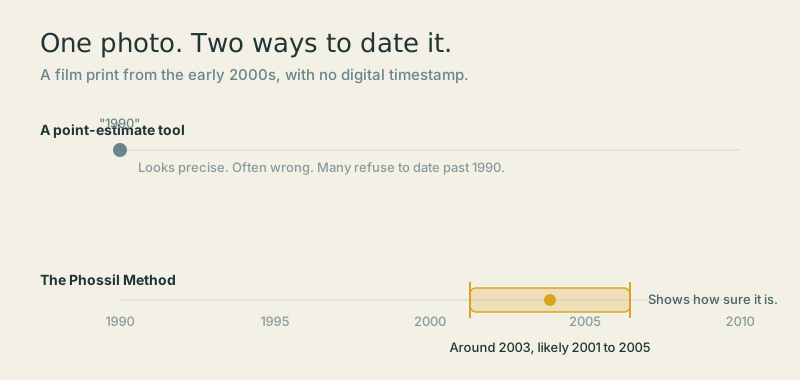
Because a single year can be checked, and when it is wrong, it is wrong in front of you. Show someone "1998" on a photo they know is their 2003 wedding, and the guess does not look clever, it looks broken. A point estimate is only safe on photos so old that nobody alive can correct it, which is exactly why a point-year tool draws its line at 1990.
The numbers back this up. PhotoDater's own figure is that "for approximately 60% of the photos, PhotoDater provided date estimations that were within 5 years of the actual dates" (MyHeritage help doc). A point that is within five years about 60% of the time is a good estimate presented as a bad promise. A range that says "most likely 2001 to 2005" is right when it contains your 2003 wedding. A point that says 1998 is simply wrong.
The design choice, in one line: Their point-estimate design forecloses the era; our honest-range design (a range and a confidence band, never a fake precise date) unlocks it.
This is not a lone opinion. Independent academic work points the same way. A 2025 paper, "Photo Dating by Facial Age Aggregation," describes "a probabilistic framework that formally combines visual evidence from modern face recognition and age estimation models, and career-based temporal priors to infer the photo capture year" (arXiv:2511.05464). That probabilistic, evidence-aggregating approach is where serious dating is heading, and it is the direction the Phossil Method already follows. You can read more about our engine on the research behind the dating.
What about photos with no people in them?
PhotoDater skips them. MyHeritage states that "estimates are calculated only for photos that do not already have a date in the metadata, that include people, and that are actual photographs, not documents or gravestones" (MyHeritage help doc). A picture of the family car, the old house, the dog in the yard, or a wide crowd where no face is clear gets no estimate at all.
The Phossil Method is not face-bound. It reads many signals at once: clothing and hairstyles, print stock and paper texture, vehicles, storefronts, furniture, and the setting itself. That is the same layered reasoning a human photo historian uses, described in our guide on how to date old photographs. Because it does not depend on a visible person, it can place a landscape, a building, or a car in time.
Does it date my whole collection?
This is the largest practical difference. PhotoDater is a single-photo feature. It works on one photo page at a time, generating an estimate in the background for that image. It is a lookup, not a library.
Phossil takes the whole shoebox. You scan your prints at home, upload them together, and the Phossil Method dates them into one connected timeline you can browse and search by decade, by person, by place. The estimates become an organized, dated archive rather than a note on one photo. Where PhotoDater asks you to check images one by one, Phossil is the archivist for all of them.
And because you scan at home, your original prints never travel. Nothing is mailed and nothing can be lost in transit. The archive is yours to keep and export at any time. You can read exactly how your photos are handled before you upload a single one.
When PhotoDater is the better choice
Fairness first, because this matters. There are real cases where PhotoDater is the right tool, and we would point you to it without hesitation:
- It is free. PhotoDater is "a FREE feature that is available on all MyHeritage platforms" (MyHeritage help doc). For a quick estimate on a single old portrait, that is hard to beat.
- Pre-1990 genealogy photos with a clear face. For a cabinet card or a mid-century portrait where someone is clearly visible, PhotoDater is trained on a curated corpus of dated historical images and does this job well.
- You already use MyHeritage. If your family tree already lives there, PhotoDater is right beside your photos with nothing new to set up.
- It is honest about uncertainty. It shows a confidence histogram rather than pretending to precision, which is the intellectually honest way to present an estimate.
If that describes what you need, use it. It is a good feature for the job it was built for.
When families choose Phossil
Families reach for Phossil when the job is bigger than one old photo:
- Your photos run past 1990. The 1990s and 2000s prints that no point-year tool will date are exactly the ones Phossil is built for.
- You want a range, not a fake year. A range with a confidence band that you can correct in one tap, rather than a single number that can be wrong at a glance.
- Your photos are not all portraits. Houses, cars, scenery, and crowds get dated too, not skipped.
- You want the whole shoebox organized. One dated, searchable timeline for the entire collection, not a note on a single image.
- You want your originals to stay home. You scan at home, nothing is mailed, and the archive is a buy-once library you own, not a yearly subscription you rent.
Start with the photos you remember
Upload your first photos and watch the Phossil Method date them into a timeline. See our buy-once plans when you are ready to bring in the rest.
See what your photos are hidingYour first 100 photos are free. No card required.
Common questions
Can Phossil date photos from the 1990s and 2000s?
Yes. MyHeritage PhotoDater estimates dates only for photos taken between 1860 and 1990. Phossil is built to date the decades after 1990, the color prints and early phone snapshots that filled the shoebox before digital cameras took over. Film prints stayed common well into the mid-2000s, so many family photos from that era are undated paper prints with no metadata. Phossil reads the visual evidence and returns a date range with a confidence band for them.
Why does Phossil give a date range instead of a single year?
A single year can be wrong in one glance. If a tool prints 1998 on a photo you know is your 2003 wedding, the guess loses your trust. PhotoDater returns a single estimated year with a confidence histogram. The Phossil Method returns a date range with a confidence band, so the answer contains the true date rather than pretending to a precision it does not have. You can correct any estimate in one tap.
Does PhotoDater work on photos with no people in them?
No. MyHeritage states that estimates are calculated only for photos that include people. Landscapes, houses, cars, and pets receive no estimate. The Phossil Method reads clothing, print stock, objects, vehicles, and setting, so it can place a photo in time even when no face is visible.
Is PhotoDater or Phossil better for genealogy photos before 1990?
For a single pre-1990 photo with a clear face, especially if you already use MyHeritage for your family tree, PhotoDater is a fine free choice. Phossil is the better fit when you want your whole collection dated and organized, when your photos run past 1990, or when you want an archive you keep and can search rather than a one-photo estimate.
Where do my photos live with Phossil?
You add your own photos, whether you scan a print or upload one that is already digital. Your originals never leave your house, so nothing can be lost in the mail. Phossil builds one organized, dated, searchable archive that is yours to keep and export at any time. It is a buy-once archive, not a yearly subscription.