Legacybox and Phossil solve two different problems. Legacybox is a mail-in service: you ship your tapes, film, slides, and prints, trained technicians digitize them by hand, and your originals come back to you with a set of digital files. Phossil is a family archive: you scan your photos at home, upload the scans, and Phossil dates, organizes, and connects them into one searchable timeline, while the physical originals never leave your house.
If you are choosing between them, the honest answer is that most families do not choose one instead of the other. They pick the tool that matches the job in front of them. This page lays out the three questions that actually decide it, with every claim traced back to the source.
How are the photos actually handled?
This is the first fork, and it is the one families feel most.
Legacybox is a mail-in operation. You buy a box, fill it with analog media, and ship it to their campus. In their own words, "Our trained Technicians digitize every item, by hand, at our 110,000 square foot campus in Chattanooga, TN" (Legacybox, How It Works). Every item is barcoded and tracked through the process, which is a genuine strength of the hand-processed model (Legacybox, How It Works). The tradeoff is simple and unavoidable: your physical originals travel through the mail, get handled at a facility, and travel back.
Phossil works the other way around. You scan your prints at home with a phone or a flatbed scanner, and you upload the scans. The physical originals stay on your table the entire time. Nothing is boxed up, nothing is shipped, and there is nothing to recover if a package goes astray. The images arrive in your archive; the objects never leave the room.
| The photos | Legacybox | Phossil |
|---|---|---|
| Who handles your physical originals | Shipped in and back; handled at their campus | Only you; originals never leave your house |
| How the images are captured | Technicians digitize each item by hand | You scan at home and upload the scans |
| What travels | Your original prints, tapes, and reels | Only the scans, uploaded from home |
What do you walk away owning?
Both services leave you with digital images. What differs is the shape of what you own afterward.
With Legacybox, you get your originals returned plus a set of digital files on a thumb drive, cloud, or DVD. They keep nothing of yours: on their blog, Legacybox says "we don't keep any of your things to ourselves" (Legacybox blog). That is a real privacy plus. The files themselves, though, arrive as a flat pile of scans. They are digitized, but they are not dated, not organized, and not searchable. The when and the who are still up to you.
With Phossil, you own a dated, organized, searchable archive of the photos you scanned. Your uploads are sorted into a timeline, connected by people and places, and always yours to export. The model is buy-once: you pay a single time for your collection and keep the archive, rather than paying per box each time you have more to convert. For reference, a Legacybox box is priced per item, where "1 item = 1 tape, 1 reel, or 25 photos" (Capture pricing analysis). The durable contrast is the model, not the price: buy once and own a dated archive, or pay per box and mail your originals away.
| What you end up with | Legacybox | Phossil |
|---|---|---|
| Form of the result | A pile of digital files, plus returned originals | A dated, organized, searchable archive |
| Are the images dated | No, files are undated | Yes, a date range with a confidence band per photo |
| Payment model | Pay per box, per item | Buy once, own the archive |
| Export | Files handed to you | Your archive, exportable any time |
What happens after digitizing?
This is where the two products stop describing the same thing.
For Legacybox, digitizing is the finish line. It converts media you often cannot scan at home, hands you the files, and the job is done. There is no organizing step, no dating step, and no timeline. If your goal is to rescue fragile tapes and reels, that finish line is exactly right.
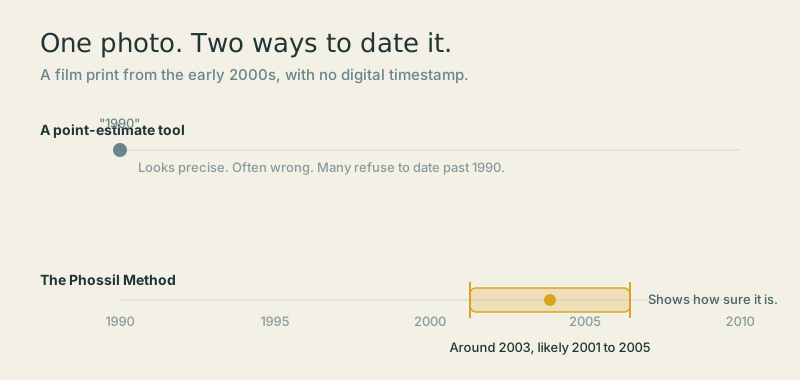
For Phossil, digitizing is the starting line. Once your scans are in, the Phossil Method reads each one and places it in time. Instead of a single fake-precise year, it returns a date range with a confidence band, and you can correct any estimate in one tap. Because it reads many clues at once, and not just faces, it can date the 1990s and 2000s color prints and phone snapshots that point-estimate tools refuse to touch. The result is a family timeline that builds itself.
You can read the method in full in the guide to dating old photographs, and see how your uploads are treated on the how your photos are handled page.
When Legacybox is the better choice
A fair comparison names the cases where the other tool wins. This is one of them.
If you have VHS tapes and film reels you want converted, Legacybox is built for that. Phossil works the other way around: you scan your photos at home and add them to your archive, and the physical originals never leave your house.
Legacybox also does something Phossil cannot: it converts media you have no way to scan at home, including VHS, 8mm and 16mm film, slides, and audio. Hand-processing genuinely helps fragile or degraded media, and for people who want zero equipment and zero labor, a mail-in box is the convenient path. If tapes and reels are what you are holding, that is the tool.
When families choose Phossil
Phossil is the right fit when the job is not conversion but organization.
- You already have scans, or a shoebox you can scan yourself. Loose prints and phone photos are exactly what Phossil is built to take in. You do the quick scan at home; Phossil does the archiving.
- You want your originals to stay home. Nothing is mailed, so nothing can be lost or damaged in transit. The physical photos stay in your house, and only the scans travel.
- You want the photos dated and organized, not just digitized. The Phossil Method turns an afternoon of manual sorting into an automatic timeline, including the recent, undated prints from the 1990s and 2000s.
- You would rather buy once than pay per box. One purchase, one archive you keep, with export never gated.
Put simply: Legacybox is the right tool for tapes and reels. Phossil is the right tool for the photos you can scan yourself and want organized and dated, not just digitized.
Common questions
Do I have to mail my original photos to Phossil?
No. Your physical photos never leave your house. You scan them at home with a phone or a flatbed scanner, and only the scans upload to your archive. Nothing is shipped, so there is nothing to lose or damage in the mail. Legacybox works the other way around: you mail your originals in, their technicians digitize them by hand, and they mail the originals back to you.
What is the difference between Legacybox and Phossil?
Legacybox is a mail-in digitizing service. You send in tapes, film, slides, and prints, and it returns digital files plus your originals. Phossil is a family archive. It dates, organizes, and connects your photos, physical or digital, into one searchable timeline. Legacybox converts your media; Phossil organizes and dates it.
Does Legacybox keep a copy of my photos?
No. On its own blog, Legacybox says it sends everything back just like it came in, and that it does not keep any of your things to itself. You get your originals back along with the digital files, and it retains nothing. With Phossil, your scans live in your own archive, and you can export them at any time.
Can Phossil convert my VHS tapes and film reels?
No. If you have VHS tapes and film reels you want converted, Legacybox is built for that. Phossil works with the photos you can scan at home. Scan your prints, upload the scans, and Phossil dates and organizes them into your archive.
How does Phossil date photos from the 1990s and 2000s?
Phossil uses the Phossil Method. It reads many visual clues at once and returns a date range with a confidence band, not a single fake-precise year. That lets it date the 1990s and 2000s color prints and phone snapshots that point-estimate tools refuse to touch. You can correct any estimate in one tap.
Do I pay per box with Phossil?
No. Legacybox charges per box you mail in, where one item counts as one tape, one reel, or 25 photos. Phossil is buy-once: you pay one time for your collection and own the dated archive, with no box to fill and no originals to ship.